Why Translation Is Not Always Understanding

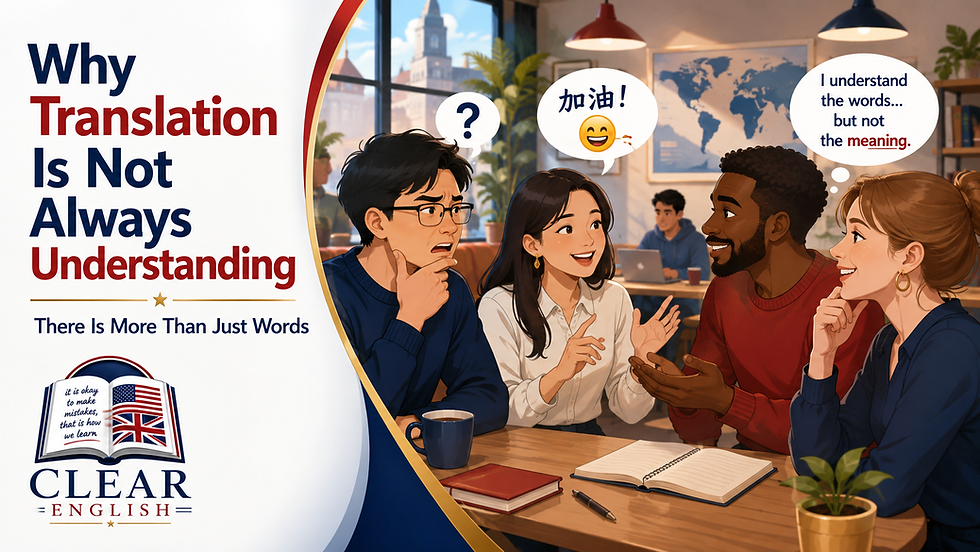
This happens to me all the time. I will say something in English to my Chinese coworkers. They may understand the words, but they do not always understand what I mean. This can cause confusion and make communication more difficult.
The same thing happens when I try to speak Chinese. I like to joke with my coworkers and students. Sometimes I will try to make a joke in Chinese, but instead of laughing, people give me a normal or confused response. This could be because my Chinese is still developing. However, there have also been times when people understood the words I used but did not understand that I was joking.
Then I explain the joke in another way, and suddenly they understand. This has taught me an important lesson:
Understanding the words is not always the same as understanding the message. I have seen this with my students as well. Students sometimes translate English into Chinese to help themselves understand. Simple sentences may be easy to translate. More difficult sentences can create problems.
When this happens, I break the sentence into smaller and simpler parts. If the student still does not understand, I may ask a teaching assistant for help. Translation can be useful, but translation alone does not always create understanding.
Words Are Only One Part of Communication
A person can know hundreds of English words but still have trouble having a real conversation. Learning a word means more than knowing its translation. You also need to understand what the word means, when people use it, and how it changes in different situations.
Some words have more than one meaning. The same sentence can also have different meanings depending on how a person says it.
Imagine someone saying:
“That was really smart.”
A person could be giving you a compliment.
But what if they say it after you make a silly mistake?
Now they might be using sarcasm.
The words did not change. The meaning did.
Tone of voice, facial expressions, body language, and the situation can all help us understand what a speaker really means.
This is one reason jokes and sarcasm can be difficult for language learners. I have experienced this myself. Sometimes my students or coworkers understand every word in my joke but do not understand why it is funny.
Maybe I am just bad at telling jokes. But sometimes, after I explain the meaning in Chinese or give more context, they immediately understand and laugh.
Idioms can create the same problem. If someone tells an English learner to “break a leg,” a word-for-word translation may sound terrible. However, in some English-speaking settings, “break a leg” is a way to wish someone good luck before a performance. The words alone do not explain the meaning.
Language and Culture Work Together
Culture is also an important part of language learning.
People from different places may have different ideas about humor, politeness, personal space, friendship, respect, and body language.
I have noticed this while living in China.
Some forms of physical contact that feel normal to me may not always feel normal to another person. I grew up around Caribbean culture, where hugging friends, relatives, and people you know well can be common. My experiences in China have sometimes been different.
However, these are personal experiences. Not every Chinese person or Caribbean person behaves the same way.
That is another important lesson about culture.
We should learn about cultural differences, but we should not assume that every person from one country will act the same way.
Understanding culture can help us avoid confusion. It can also help us understand why someone may speak or act differently from what we expect.
Learning another language should include learning how people actually communicate with one another.
Translation Apps Help, but They Are Not Perfect
Translation apps are very useful.
I use them, and many language learners use them every day. They can help when two people cannot understand each other or when someone needs to find the meaning of a word quickly.
However, translation tools can make mistakes.
They may translate the words correctly but miss the meaning of the full sentence. They can also have trouble with jokes, idioms, cultural expressions, and sentences that need more context.
This does not mean we should stop using translation technology.
It means we should understand its limits.
If a translation sounds strange, ask someone. Look at the situation. Try another way of saying it. Do not automatically assume that the first translation is correct.
Adults Need More Than Vocabulary
When adults learn English, I believe three important goals should be building confidence, speaking clearly, and improving listening skills.
There is no single moment when every learner must stop translating and begin thinking only in English. Every person develops at a different pace.
However, when a learner can hear a question in English and respond naturally in English, that is a good sign of progress.
It does not mean the learner is completely fluent.
It means they are beginning to understand English without having to translate every word first.
Teachers can help this process in many ways.
They can use books, technology, games, pictures, writing, speaking activities, physical actions, and real conversations.
Role-play can be especially useful when teaching tone, humor, intent, and context.
For example, students could practice the same sentence in different ways. They could say it happily, angrily, jokingly, or seriously. Then they can discuss how the meaning changes.
This helps students understand that communication is about more than vocabulary and grammar.
It Is Okay to Ask
One of the most important skills in language learning is also one of the simplest:
Ask questions.
If you do not understand something, ask.
“What do you mean?”
“Can you explain that?”
“Are you joking?”
“Can you say that another way?”
There is nothing wrong with asking for clarification.
It is better to learn something new than to guess and understand something incorrectly.
Translation is not absolute. Apps, artificial intelligence, human translators, teachers, and language learners can all make mistakes. That is okay.
It is okay to make mistakes. That is how we learn. Translation can help us cross a language barrier, but real understanding requires more. We must learn how words, tone, culture, context, and people work together.
Ask questions. Take your time. Make mistakes. And most importantly, have fun while learning.
Note: This article is written in a reflective language-learning format, exploring how English communication, cultural understanding, and real-world language use interact across different contexts.
Sources
Baziotis, Christos, Prashant Mathur, and Eva Hasler. “Automatic Evaluation and Analysis of Idioms in Neural Machine Translation.” Proceedings of the 17th Conference of the European Chapter of the Association for Computational Linguistics, Association for Computational Linguistics, 2023, pp. 3682–3700. doi:10.18653/v1/2023.eacl-main.267.
Byram, Michael. Teaching and Assessing Intercultural Communicative Competence: Revisited. 2nd ed., Multilingual Matters, 2021.
Fernandes, Patrick, et al. “Measuring and Increasing Context Usage in Context-Aware Machine Translation.” Proceedings of the 59th Annual Meeting of the Association for Computational Linguistics, Association for Computational Linguistics, 2021.
Horwitz, Elaine K., Michael B. Horwitz, and Joann Cope. “Foreign Language Classroom Anxiety.” The Modern Language Journal, vol. 70, no. 2, 1986, pp. 125–132. doi:10.1111/j.1540-4781.1986.tb05256.x.
Kecskes, Istvan. Intercultural Pragmatics. Oxford UP, 2013. doi:10.1093/acprof:oso/9780199892655.001.0001.
Kim, Jiyun. “How Korean EFL Learners Understand Sarcasm in L2 English.” Journal of Pragmatics, vol. 60, 2014, pp. 193–206. doi:10.1016/j.pragma.2013.08.016.
Koh, Joanne, Sineun Lee, and Josephine Mijin Lee. “L2 Pragmatic Comprehension of Aural Sarcasm: Tone, Context, and Literal Meaning.” System, vol. 105, 2022, article 102724. doi:10.1016/j.system.2022.102724.
UNESCO. Languages Matter: Global Guidance on Multilingual Education. UNESCO, 2025.
Comments