Energy and Power: Why Nations Fight for Resources

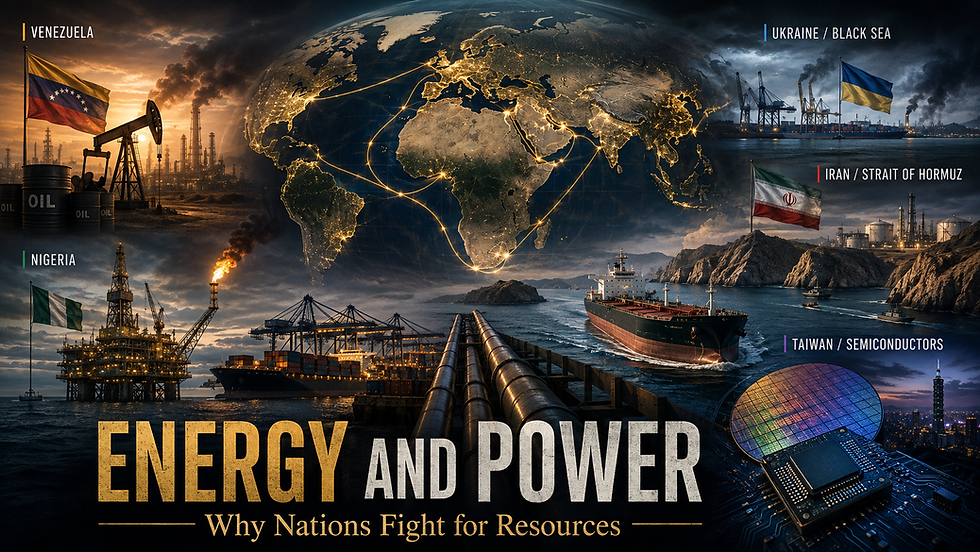
Resources are anything people and governments need in order to survive, grow, and maintain power. This includes oil, food, water, minerals, land, trade routes, and semiconductors. Each resource serves a different purpose, but they all affect how societies function. Without resources, governments weaken, economies suffer, and populations become harder to protect.
Resources become especially important during war. Armed conflict consumes enormous amounts of fuel, food, weapons, vehicles, ammunition, and technology. Once these materials are destroyed or exhausted, they must be replaced. A country that can replace its losses faster than its enemy has a major advantage. World War II showed this clearly. Countries with secure trade routes, industrial capacity, and access to resources were in a stronger position than countries stretched thin by blockade, bombing, and shortages.
In my view, modern conflicts are often shaped by two major forces: resources and ideology. Governments may speak about freedom, security, democracy, religion, sovereignty, or human rights. Some of these concerns may be sincere. However, it is also true that nations often become more active when strategic resources are involved. There have been massacres and humanitarian disasters around the world where outside powers could have intervened but did not. This raises an uncomfortable question: why do some crises receive major international attention while others are ignored?
One possible answer is material interest. External powers may become involved in unstable regions because they want influence, trade access, energy security, or strategic positioning. This does not mean every intervention is fake or evil. Some interventions may genuinely protect civilians or stabilize dangerous situations. But it would be naïve to believe that powerful states act only out of compassion. National interest is almost always present.
Oil and gas remain central to global politics. In some ways, they may matter even more today because modern economies depend on transportation, production, shipping, heating, electricity, and military mobility. At the same time, semiconductors have become one of the most important resources of the digital age. Computers, phones, vehicles, artificial intelligence, drones, and advanced weapons all depend on chips. This is why Taiwan, which China claims as part of its territory, matters so much. Taiwan is not only a sovereignty question. It is also a semiconductor flashpoint.
Iran and the Strait of Hormuz show how geography and energy can shape global tension. The Strait of Hormuz is one of the world’s most important oil chokepoints. When conflict threatens shipping there, the consequences can reach far beyond the Middle East. Oil prices can rise, shipments can slow, production can stall, and countries far away can feel the pressure. In this sense, the Strait of Hormuz can be compared to the Panama Canal or Suez Canal. These narrow routes matter because they make global trade faster, cheaper, and more predictable. When they are threatened, the world feels it.
Venezuela also plays an important role in global politics because of its oil supply. Its political crisis, disputed elections, migration pressures, sanctions, and tense relationship with the United States have made it more than a domestic issue. The United States recognized opposition candidate Edmundo González as the winner of Venezuela’s disputed 2024 election, while Nicolás Maduro’s government rejected the opposition’s claims and remained at the center of the crisis. Venezuela’s oil reserves make the country strategically important, but the situation cannot be explained by oil alone. It also involves democracy, legitimacy, regional influence, organized crime, migration, and U.S. interests in the Western Hemisphere.
Nigeria shows another side of the resource problem. It is Africa’s most populous country and has major oil and natural gas resources, yet it continues to struggle with terrorism, banditry, kidnapping, poverty, corruption, and weak state control in several regions. Nigeria demonstrates that having resources does not automatically create stability. In fact, resources can become targets when armed groups, criminal networks, and political factions compete for control.
Ukraine also fits this discussion. Russia’s invasion of Ukraine is not only about resources. It is also about security, identity, NATO, historical claims, and Russian influence. However, geography and resources still matter. Ukraine’s agricultural production, Black Sea access, ports, energy infrastructure, and trade routes all increase its strategic value. The disruption of Black Sea shipping has affected grain exports and global food markets, showing how a regional war can create worldwide economic consequences.
This connects to the broader Second Cold War argument. Today’s world is not divided exactly like the twentieth-century Cold War, but major powers are again competing for resources, technology, trade routes, influence, and strategic territory. Oil, gas, semiconductors, food, water, and minerals are not just economic goods. They are instruments of power.
The war in Ukraine also shows that manpower alone does not win modern wars. Drones, missiles, cyber systems, satellites, armored vehicles, and air defenses require complex supply chains. To keep fighting, states need fuel, factories, chips, rare materials, money, and secure logistics. Military power depends on resource power.
I do not believe nations should fight for resources if trade, diplomacy, and fair agreements are possible. However, the harsh reality is that many governments do not trust one another. Some fear dependency. Others want dominance. Some want survival. Others want wealth. When trust collapses, resources become not only tools of prosperity but reasons for conflict.
Based on what I understand, resources and energy show that modern conflict is becoming more intense because governments are preparing for uncertainty. Some conflicts are driven by need. Others are driven by ambition. But in either case, resources remain at the center of power.
Do nations fight for ideals, or do they fight for the resources that make power possible?
Are modern conflicts mostly about ideals, security, or resources?
Can diplomacy reduce resource competition, or will powerful states always seek control over strategic assets?
Is Taiwan’s semiconductor industry proof that technology has become the new oil?
Note: This article was written to encourage thoughtful discussion on contemporary global affairs. The analysis presented reflects an examination of current events, geopolitical developments, and strategic considerations. Its purpose is not to provide definitive answers, but to explore important questions, challenge assumptions, and promote informed dialogue.
Sources
International Energy Agency. World Energy Outlook 2025. IEA, 2025.
U.S. Energy Information Administration. “The Strait of Hormuz Is the World’s Most Important Oil Transit Chokepoint.” Today in Energy, U.S. Energy Information Administration, 21 Nov. 2023.
U.S. Energy Information Administration. Country Analysis Brief: Venezuela. U.S. Energy Information Administration, 2024.
World Bank. Nigeria Development Update: Positive Economic Momentum in Nigeria, Now Time to Bring Home the Gains. World Bank, 2025.
World Bank. Nigeria Development Update. World Bank, 2025.
Reuters. “Shipping Traffic via Strait of Hormuz Stays below 10-Day Average, Data Shows.” Reuters, 2 Sept. 2026.
Reuters. “Russian Grain Exports Shift to Baltic as Black Sea Trade Disrupted.” Reuters, 31 Aug. 2026.
Reuters. “Ships Adopt Makeshift Anti-Drone Defences as Black Sea Attacks Intensify.” Reuters, 2 Sept. 2026.
Associated Press. “US Oil Giant Chevron Confirms It Will Expand Operations in Venezuela.” AP News, 2 Sept. 2026.
Council on Foreign Relations. “Why China-Taiwan Relations Are So Tense.” Council on Foreign Relations, 2026.
Comments