Discipline Systems in a Zero-Authority Era

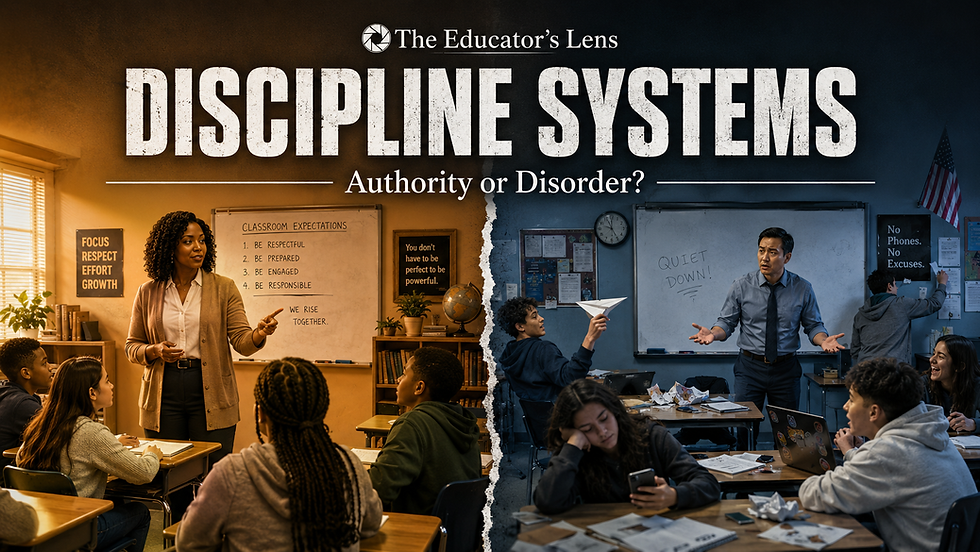
Schools are experiencing both a discipline problem and an authority problem. Many teachers are entering what feels like a “zero-authority era.” This does not mean teachers have no authority at all. It means teachers are still expected to maintain classroom order, but many of the systems that support teacher authority have been weakened, delayed, or removed.
Teachers are expected to keep students focused, respectful, safe, and academically engaged. However, when consequences are inconsistent, administrative support is unclear, and parent cooperation is unreliable, teacher authority becomes fragile. Students may still respect many teachers, but that respect has gradually weakened in some school environments. Once students realize that teachers have limited power to enforce consequences, some become more willing to ignore rules, skip class, disrupt instruction, or engage in behavior that damages their own learning and the learning of others.
Teachers still have some power to manage student behavior, but that power often depends on planning, documentation, and coordination with administrators, counselors, and families. Inside the classroom, teachers should have the authority to correct behavior, enforce classroom rules, document repeated disruptions, contact families, and request the removal of students who are consistently disruptive or dangerous.
This does not mean teachers should have unlimited disciplinary power. Major decisions such as suspension, expulsion, or transfer should remain administrative decisions. Teachers may recommend those actions when behavior seriously affects safety or learning, but they should not be the final authority on life-changing disciplinary outcomes. Administrators must review the evidence, consider context, communicate with families, and ensure that due process is followed.
Teacher authority becomes weak when a consequence issued in the classroom is softened, ignored, or reversed without explanation. When students see that classroom rules are not backed by the larger school system, they learn that teacher authority is negotiable. I have seen students ignore teachers, including myself, when they believed that certain disciplinary actions could not or would not be enforced.
School consequences vary widely from school to school. Strong consequences can deter misbehavior, but consequences must be fair, proportionate, and connected to the offense. A consequence should not simply punish a student. It should correct behavior, restore order, and protect the learning environment.
For example, if a student intentionally skips class, it may be reasonable for that student to lose recess or free time until the missed coursework is completed. The consequence directly connects to the behavior. The student avoided academic responsibility, so the response requires the student to complete the academic responsibility they avoided. That is corrective.
A weak consequence would be giving the student only a short conversation with no follow-up, no accountability, and no requirement to make up the missed work. Students need reflection, but reflection without action often becomes a speech rather than a consequence. On the other hand, an excessive consequence would be suspending a student for several days for one skipped class. That may remove the student from school but does not necessarily solve the original problem.
Consequences should focus on correction, restoration, and protection. If a student repeatedly disrupts class, the response should escalate. Repeated behavior should not reset every day as if nothing happened. Schools need a clear process that includes documentation, teacher communication, parent contact, counselor involvement, administrator review, and support plans when needed.
Restorative practices can be useful in this process, but only when they include accountability. A restorative conversation can help a student understand who was affected, what harm was caused, and how trust can be repaired. However, restorative practices become weak when they are used to excuse repeated misconduct or avoid consequences. Restoration without accountability becomes permission.
Parent involvement is essential. I have learned firsthand that when parents are not involved in the discipline and education of their children, correcting behavior becomes much more difficult. When parents automatically defend their child from every consequence, they teach the child that rules can be avoided through denial, blame, or pressure. This may hurt the child later in life when consequences outside of school are much harsher and less forgiving.
At the same time, schools also have responsibilities. If schools fail to communicate honestly with parents, they weaken trust. Parents should not be surprised by serious behavior problems only after the situation has become severe. Teachers and administrators must communicate clearly, respectfully, and directly. There should be no sugarcoating, but there should also be no humiliation or hostility.
Schools and families should not treat each other as enemies. Parents should advocate for their children, but advocacy should not mean automatic denial of responsibility. Schools should protect students, but protection should not mean avoiding accountability. Discipline works best when schools and families agree that children need structure, correction, and support.
The rights of students, teachers, parents, and administrators should be clearly stated and visible within the school community. Students should know their rights, but they should also know their responsibilities. Teachers should know what authority they have. Parents should know how behavior concerns will be communicated. Administrators should know when they are expected to intervene.
A school-wide standard for behavior is important. If every classroom has completely different expectations, students receive mixed messages. A common discipline framework helps students understand that rules are not based only on one teacher’s personality. The school as a whole must stand behind the expectations.
Student rights matter. Students should not be humiliated, targeted unfairly, or removed from class without reason. However, the rights of one disruptive student cannot erase the rights of every other student in the room. Other students have the right to learn, listen, work, feel safe, and participate without constant interruption. A fair discipline system must protect both the individual student and the larger learning community.
Teachers are often blamed for behavior problems they are not fully allowed to fix. Teachers are expected to teach, mentor, tutor, guide, communicate with parents, support student mental health, maintain safety, and manage classroom behavior. When a fight, emotional crisis, or major disruption happens, the teacher is often judged first. Parents and administrators may expect the teacher to resolve the problem alone. If the teacher cannot, they may be labeled ineffective.
This is unfair. Classroom management is one of the foundations of effective teaching, but classroom management is not only a teacher skill. It is also a school system. Teachers can set expectations, build relationships, create routines, enforce classroom consequences, and document concerns. But teachers do not control parent cooperation, administrative follow-through, class size, school policy, counseling access, student placement, or broader school culture.
Teachers are academic instructors. They should understand student behavior and mental health warning signs, but they are not doctors, psychologists, or social workers. When students have serious mental health concerns, physical disabilities, trauma, or behavioral conditions, schools need proper support systems. These students deserve help from trained professionals, and teachers deserve support from departments or specialists equipped to handle those needs.
Students who repeatedly disrupt learning should receive structured intervention, not endless chances with no change. The response should begin with classroom correction and documentation. If the behavior continues, parents should be contacted. If it still continues, counselors and administrators should become involved. If there are possible mental health, family, disability, or outside factors, those concerns should be addressed through proper support channels.
However, support cannot mean allowing one student to continuously damage the learning environment for everyone else. If interventions, parent meetings, counseling referrals, behavior plans, and administrative support do not lead to improvement, then stronger actions may be necessary. These may include temporary removal, suspension, alternative placement, or, in serious cases, transfer or expulsion.
The purpose of discipline is not revenge. The purpose of discipline is to teach responsibility, restore order, protect learning, and help students understand that actions have consequences. A school without discipline is not compassionate. It is unstable. A school that removes all authority from teachers does not protect students. It weakens the learning environment for everyone.
Schools cannot demand classroom order while removing the authority needed to maintain it. A fair discipline system must protect student rights, but it must also protect teacher authority and every student’s right to learn.
Note: This article is written in a reflective interview format, exploring how education systems and classroom realities interact across different contexts.
Sources
American Psychological Association Zero Tolerance Task Force. “Are Zero Tolerance Policies Effective in the Schools? An Evidentiary Review and Recommendations.” American Psychologist, vol. 63, no. 9, Dec. 2008, pp. 852–862. American Psychological Association, https://www.apa.org/pubs/reports/zero-tolerance. Accessed 2 Sept. 2026.
Centers for Disease Control and Prevention. “Promoting School Connectedness Through Restorative Practices.” CDC, U.S. Department of Health and Human Services, https://www.cdc.gov/youth-behavior/school-connectedness/restorative-practices.html. Accessed 2 Sept. 2026.
Darling-Hammond, Linda, and Channa M. Cook-Harvey. Educating the Whole Child: Improving School Climate to Support Student Success. Learning Policy Institute, 2018, https://learningpolicyinstitute.org/product/educating-whole-child-report. Accessed 2 Sept. 2026.
Darling-Hammond, Sean. Fostering Belonging, Transforming Schools: The Impact of Restorative Practices. Learning Policy Institute, 2023, https://learningpolicyinstitute.org/product/impact-restorative-practices-report. Accessed 2 Sept. 2026.
Institute of Education Sciences. Reducing Behavior Problems in the Elementary School Classroom. What Works Clearinghouse, U.S. Department of Education, Sept. 2008, https://ies.ed.gov/ncee/wwc/Docs/PracticeGuide/behavior_pg_092308.pdf. Accessed 2 Sept. 2026.
Institute of Education Sciences. Teacher-Delivered Behavioral Interventions in Grades K–5. What Works Clearinghouse, U.S. Department of Education, Dec. 2024, https://eric.ed.gov/?id=ED662158. Accessed 2 Sept. 2026.
National Center on Safe Supportive Learning Environments. Addressing the Root Causes of Disparities in School Discipline: An Educator’s Action Planning Guide. U.S. Department of Education, July 2015, https://eric.ed.gov/?id=ED580917. Accessed 2 Sept. 2026.
Simonsen, Brandi, et al. “Evidence-Based Practices in Classroom Management: Considerations for Research to Practice.” Education and Treatment of Children, vol. 31, no. 3, 2008, pp. 351–380. ERIC, https://eric.ed.gov/?id=EJ798223. Accessed 2 Sept. 2026.
U.S. Department of Education. “School Climate and Student Discipline Resources.” U.S. Department of Education, https://www.ed.gov/teaching-and-administration/safe-learning-environments/school-safety-and-security/school-climate-and-student-discipline/school-climate-and-student-discipline-resources. Accessed 2 Sept. 2026.
U.S. Department of Education. “School Climate and Student Discipline Resources: Support School Staff.” U.S. Department of Education, https://www.ed.gov/teaching-and-administration/safe-learning-environments/school-safety-and-security/school-climate-and-student-discipline/school-climate-and-student-discipline-resources-support-school-staff. Accessed 2 Sept. 2026.
Comments